
Home/Products/FRP tanks, piping and process equipment
FRP tanks, piping and process equipment
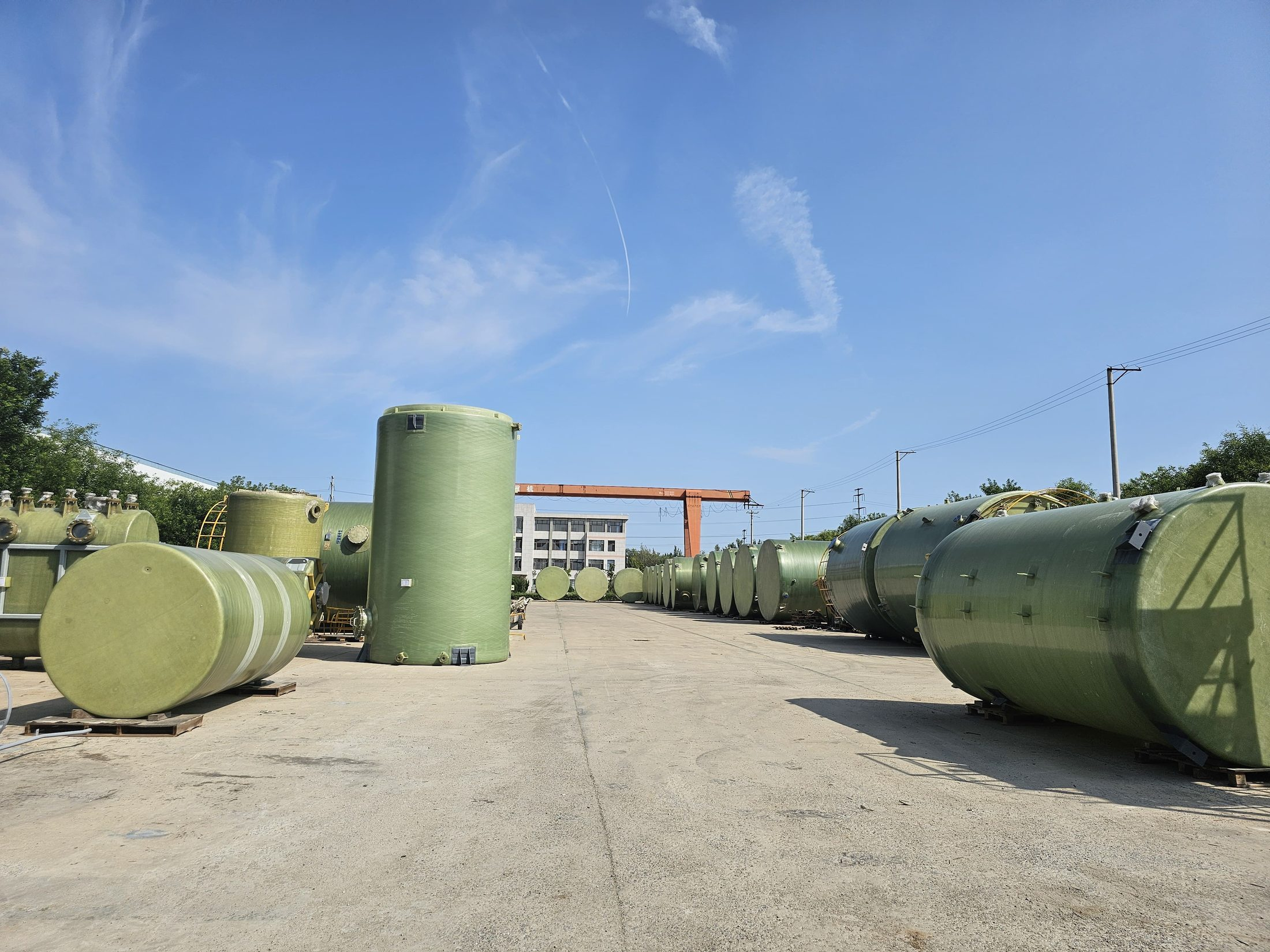
SBCCO-China supplies corrosion-resistant FRP tanks, pipe, ductwork, scrubbers, covers, internals and access products from China. Equipment is selected for the actual liquid or gas, concentration, temperature, pressure and installation conditions. Shop fabrication, transportable sections and site assembly are evaluated with the project team.
01
Supply scope
The supply scope ranges from a replacement nozzle or pipe spool to a coordinated tank-and-piping package. A corrosion-resistant liner, structural laminate and external protection perform different jobs. The purchase specification should identify them separately, together with the design loads and the equipment interfaces. A resin name by itself does not define a suitable vessel.
Tanks and vessels
Storage tanks, pump tanks, acid wash columns and process vessels, with nozzles, supports and internals defined by the approved equipment drawing.
Pipe and ductwork
Straight pipe, fittings, transitions and gas ducts supplied against line geometry, connection details and the agreed pressure or vacuum duty.
Scrubbers and gas-handling equipment
Scrubber shells, mist eliminator housings, dampers and associated piping. The process designer establishes removal duty and operating conditions.
Covers and internals
Thickener covers, feedwells, launders, weirs and collection systems, coordinated with the supporting steel, concrete basin and maintenance access.
02
Documented specifications and selection basis
These are documented product ranges and project examples. They help define an enquiry; the selected equipment is confirmed against its own duty, drawings and acceptance requirements. A historical shipment is not a statement of a shop’s current maximum capacity.
| Item | Specification and scope |
|---|---|
| Cylindrical tanks | DN500–DN25,000 mm in the product list; rectangular tanks are custom-sized. Transport and project design determine the final arrangement. |
| Pipe and fittings | 25–4,000 mm in the FRP piping brochure. The product list also includes DN20; confirm the selected construction at the small-diameter end. |
| Scrubber shells | DN500–DN25,000 mm listed as a fabrication range, subject to duty, structural design and transport. |
| Construction | Filament winding or contact moulding, with resin system, corrosion barrier, reinforcement and cure requirements specified for the equipment. |
| Rating and laminate | Pressure, vacuum, temperature, wall thickness and nozzle loads are established for the individual item; diameter alone is not a rating. |
03
Service conditions and applicable standards
Start with the complete operating envelope, including cleaning, startup and upset conditions. An atmospheric tank can still experience vacuum during draining or a blocked vent. Pipe supports, flange loads, lifting points and the site environment belong in the design review. For a retrofit, survey the existing interfaces before assigning responsibility for fit-up. Where abrasion accompanies corrosion, describe the solids rather than asking for a corrosion-resistant resin alone.
ASTM D3299 addresses filament-wound corrosion-resistant tanks; ASTM D4097 addresses contact-moulded tanks. ASME RTP-1 is an equipment design and fabrication standard with a separate fabricator-certification program. BS EN 13121 is also referenced in the supply literature. Specify the applicable standard and edition for the item. A project built to a code and an ASME-certified manufacturer are different claims; any required certification is checked for that order.
04
Inspection and release documents
The inspection plan turns the purchase specification into manufacturing checkpoints. Before production, identify the drawing revision, material requirements, acceptance limits and required records. Separate mandatory hold points from progress observations so that an inspection visit happens while the work can still be checked. If the order includes a third-party witness, the attendance and release arrangements belong in the schedule.
For this product line, the review focuses on resin and reinforcement identification, approved laminate schedule, cure and thickness checks, flange dimensions, nozzle orientation and the specified pressure or leak test. The final document list is agreed with the order: material records, dimensional reports, applicable fabrication and test records, release information and packing identification. Changes or deviations are resolved against the approved specification before acceptance, with the responsible engineer involved where required.
05
Project references with measured scope
PASAR acid-service pump tank
The 2019 FRP reference list records one 47 m³ pump tank for PASAR. SBC’s packing list dated 12 June 2019 records the pump-tank shipment at 4,090 kg net and 6,500 kg gross, with a 5,100 × 5,100 × 4,300 mm shipping envelope. Those dimensions describe the packed shipment. They are not the tank’s internal dimensions, and the gross weight is not the vessel design weight.
28 m³ acid wash column for FLSmidth
The FRP reference list records one 28 m³ acid wash column for Crimar / FLSmidth in June 2016, with ASME RTP-1 as the recorded design code. This is a project reference for a particular vessel and service. A new column requires its own chemical duty, dimensions, laminate design and inspection requirements; the historical code entry is not a claim that every fabricator holds an ASME authorization.
Reference supplied by our sister company, Crimar Industrial.
06
What to send for a quotation
Send fluid or gas composition, concentration, normal and upset temperature, pressure and vacuum, volume, dimensions, nozzle schedule, support loads, resin restrictions and the site wind or seismic basis. Include quantities, the required date at site, the destination port or plant and the preferred delivery terms. If you are replacing existing equipment, add photographs showing connections, access and the failure or wear pattern. Mark dimensions that have been measured on site and identify any values still awaiting confirmation.
For a comparable quotation, define the battery limits: equipment, bought-out components, supports, drawings, inspection, packing and transport. Ask for technical exceptions and exclusions alongside the price. This makes it possible to compare proposals on the same scope and prevents an omitted inspection, connection or document from becoming a site problem. A preliminary budget can proceed with stated assumptions; manufacture follows the approved final requirements.
07
Buyer questions
Can you supply a large tank that will not fit in a container?
Yes, a segmented or site-assembled arrangement can be evaluated. The catalogue diameter is a fabrication reference, not proof that a complete vessel can travel to your site. Confirm route restrictions, assembly access, foundations, lifting and field quality controls before deciding the manufacturing split.
What information do you need to quote?
Send fluid or gas composition, concentration, normal and upset temperature, pressure and vacuum, volume, dimensions, nozzle schedule, support loads, resin restrictions and the site wind or seismic basis. Include the required delivery date, destination and inspection requirements. Identify which information is preliminary and which drawing is approved. We can then return a scoped proposal with technical assumptions, exclusions, documentation and the proposed delivery basis, rather than a price based only on a product name.
How is the inspection scope agreed?
Use an item-specific inspection and test plan. For this equipment it should address resin and reinforcement identification, approved laminate schedule, cure and thickness checks, flange dimensions, nozzle orientation and the specified pressure or leak test. Identify hold and witness points before production and link the final records to the equipment marks. Where independent inspection is required, agree the inspector and attendance scope before the relevant manufacturing stage.
Can you use the material or standard named in our specification?
Yes, subject to review of the actual item and manufacturing route. Name the standard and edition, material grade, required condition and acceptance criteria in the enquiry. If an alternative is proposed, the difference is stated for agreement before manufacture. Material equivalence, equipment design and manufacturer certification are separate questions and should be resolved separately.
What is the lead time and is the equipment in stock?
Delivery is quoted for the particular order. The schedule depends on drawing approval, material availability, manufacturing, inspection, packing and transport. Give the required site date and identify shutdown constraints so the proposal can separate the production and shipping stages. The examples on this page describe supply capability and past work; they are not an offer of stock or a fixed catalogue lead time.
Can you coordinate packing and shipment to our site?
Yes, with the shipping scope and destination agreed in the order. Confirm package dimensions and weights, lifting arrangements, preservation, unloading access and any assembly needed after delivery. Large equipment may travel in sections or require a special shipping arrangement. Packing dimensions and gross weights are identified separately from the dimensions and net weight of the equipment.
Can I use a past project as the specification for a new order?
Use the reference to identify comparable equipment, then specify the new duty. A recorded quantity, capacity or shipping weight applies to that project and is not a universal operating limit. Where a reference comes from our sister company, the attribution appears beside the case. Send your current operating conditions and interfaces so the new proposal can establish the correct construction and acceptance basis.
08
Discuss your equipment
Send your drawing, operating conditions and required site date. SBCCO-China will review the supply scope, materials, inspection and delivery requirements.
Download an enquiry guide
Download directly; no email address is required.